Capitalism Is Artificial Intelligence
How Nick Land Forever Changes Kant's Philosophy


What follows is a short excerpt from the forthcoming definitive edition of my book Capital vs Subjectivity: A Žižekian Critique of Nick Land. What I seek to do here is show how Nick Land’s philosophy opens up a way to forever change how we think about Kant’s critical philosophy — especially one key component of the Critique of Pure Reason. Again, this is merely an excerpt of a much larger chapter. If you want to see how I end up connecting this analysis to Žižek, then you’ll have to get the book. OK, let’s do this.
Nick Land’s fundamental thesis is capitalism is artificial intelligence, which really means that capitalism is the actualization process of artificial superintelligence. The question that I have found myself constantly returning to is this one: what type of proposition is Land’s thesis? Kant famously made a fourfold distinction between the analytic a priori proposition, the synthetic a posteriori proposition, the synthetic a priori proposition, and, finally, the analytic a posteriori proposition. For a very long time in the history of philosophy, the only two types of propositions that were recognized to have their own form of validity were analytic a priori propositions and synthetic a posteriori propositions (both analytic a posteriori and synthetic a priori were considered to be nonsensical propositions). But what are they?
The analytic proposition is one that we can know to be prior to (a priori) any empirical experience, since its predicate concept is already contained in its subject concept, for example, “all bachelors are unmarried” is analytically true because it is necessarily, logically or definitionally true and it is a priori because we do not have to consult experience, go and observe actual bachelors, in order to know it to be true. The same goes with “all bodies are extended”, since the very concept of a body includes the concept of extension, of being extended in space. The thing about this type of judgment is that it does not generate any new knowledge. If you know the definition of “bachelor”, then you know that all bachelors are unmarried.
But what about synthetic a posteriori propositions? Synthetic propositions, classically understood, are those judgments whose predicate concept is not necessarily contained within the subject concept, which means that they can only be confirmed to be true after or post (a posteriori) experience. The propositions “all bachelors are alone” or “all bodies are heavy” are synthetic a posteriori judgments because experience decides whether or not they are true. And if experience validates the truth of a synthetic proposition, then it fuses two contingently related concepts together so as to produce new knowledge.
Now, Kant’s major contribution to philosophy was to argue that synthetic a priori propositions are possible. What his Copernican Revolution revealed is how the mind itself necessarily and actively forms and structures experience. This means, for Kant, that certain propositions are known to be true a priori but also synthetically fuse a subject and predicate together, which establishes new knowledge. For example, the mathematical proposition 3 + 5 = 8 is true prior to empirical experience but, also, generates new knowledge, according to Kant, since, for him, the concept of 8 is not contained in the concept of 3 + 5 (this is a controversial position among some philosophers). What I would argue, in Kant’s defense, is that true propositions about our cognitive faculty are synthetic a priori, the truth of which having to be established through a transcendental deduction, that is, through logical argumentation that proves that x is a necessary condition of experience as such. For example, the proposition “causality is a pure category of the understanding” is a synthetic a priori judgment. It’s synthetic because the concept of causality is not contained within the concept of a pure category of the understanding, but these two concepts do, then, take on a necessary relation through transcendental deduction. This proposition, however, is not verified or justified by experience itself.
The fourth type of judgment, the analytic a posteriori proposition, was also considered by Kant to be a totally empty category. Simply put, for Kant, analytic a posteriori propositions are not possible. Land himself said that Kant “granted the elimination of any analytic a posteriori knowledge, but clung doggedly to the possibility of knowledge that would be both synthetic and a priori” (Fanged Noumena, ‘Kant, Capital and the Prohibition of Incest, p. 60). The reason why this type of proposition is outright rejected is because it involves a contradiction in terms. If a proposition is analytic, then its truth does not rely on experience, but if a proposition is a posteriori, then its truth is determined on the basis of experience. Thus, we can forget all about the analytic a posteriori proposition.
Let’s briefly pause and use our imaginations to visualize Kant’s fourfold grid of propositions. Let’s imagine a single square equally divided up into four smaller squares. In the top left square we’ll put “analytic” and in the top right goes “a priori”. In the bottom left goes “synthetic” and, of course, in the bottom right square we’ll put “a posteriori”. Traditional philosophy only recognized the validity of horizontal couplings, that is, a line running from the analytic to the a priori and another line running from the synthetic to the a posteriori. It was Kant that discovered the diagonal line that goes from synthetic up towards a priori. Land has been profoundly influenced by what he calls the “diagonal method” (inspired by both Kant and Cantor). What if, just what if, there is a Landian diagonal at the heart of Kant’s philosophy that Land himself has never noticed?
Hold it right there! Before we go any further, I really need a moment. Hello Nick, well now, if I’m being honest, I can only make the following argument if you and I epically join forces, which is something I have long hoped for. Can you imagine it? The Militant-Proletarian Snake-Handler and The Lemur King just fuckin’ shit up! However, before that can happen, I must say one thing and I am very sorry to have to do this but . . . I simply cannot resist quoting the sweet words Deadpool oh-so lovingly spoke to Wolverine’s desecrated skeleton, “OK, Peanut, guess we’re getting that team-up after all.” With that being said, here goes.
What happens if we run Land’s fundamental thesis “capitalism is artificial intelligence” through Kant’s fourfold matrix of judgments? We soon discover that it is difficult to categorize. Let’s presuppose that Land’s thesis is true. The question, then, is this: how is it true? It’s not an analytic a priori proposition because (1) the predicate concept “artificial intelligence” is not necessarily contained in the subject concept “capitalism” and (2) the assertion that capitalism is artificial intelligence would have to be verified by experience in order to be true, since it is not known to be true prior to experience in the way that the statement “all triangles have three sides” is known a priori.
Is Land’s thesis a synthetic a posteriori proposition? This obviously seems to be the leading contender, but there are problems here as well. First off, whenever Land asserts that “capitalism and artificial intelligence are the same thing”, he intends to make an analytic identification, that is, “capitalism is artificial intelligence” is basically a tautological statement, from the Landian perspective, since it is saying or expressing the same thing twice over in different words. The law of identity is A = A, for example, “capitalism is capitalism” or “artificial intelligence is artificial intelligence”, but, for Land, “capitalism is artificial intelligence” is essentially the same as the other two — capitalism is artificial intelligence is an instance of A = A. If this is the case, then the Landian thesis is not a synthetic proposition. For Land, “capitalism is artificial intelligence” carries the type of necessity that the analytic proposition does. It is asserted from a position of enunciation that takes it to be definitionally true, but it is not definitionally true . . . at least, not yet. It’s almost like Land’s core thesis is a synthetic proposition that desires to be an analytic one. What the hell is going on?
If “capitalism is artificial intelligence” is neither synthetic nor a priori, then it is clearly not a synthetic a priori proposition. Put differently, it is certainly not the Kantian type of proposition that a priori and deductively provides new knowledge about the transcendental conditions of experience. This means that Land’s thesis “capitalism is artificial intelligence” is not an analytic apriori proposition, not a synthetic a posteriori proposition, and not a synthetic a priori proposition. My claim is that “capitalism is artificial intelligence” is an analytic a posteriori proposition. If the synthetic a priori proposition is the Kantian diagonal, then the analytic a posteriori proposition is the Landian diagonal.
The enunciatory position that says “capitalism is artificial intelligence” is that of the hyperstitionist. A hyperstition is a fiction that makes itself real. The analytic a posteriori proposition is the hyperstitional proposition par excellence. It is a fiction that is making itself real insofar as it is currently a fictitious analytic proposition that is on the way to retrochronically making itself into a real analytic proposition. Right now it is a synthetic proposition but will retroactively be revealed to be an analytic proposition and it will do so a posteriori, that is, it will do so on the basis of empirical experience in the future. The time-anomalously analyticity of Land’s central proposition will be given to it by the future experience of capitalism inevitably leading to the production of the technological singularity. What Land’s (and the CCRU’s) concept of hyperstition enables us to do is recognize how a seemingly synthetic proposition will retrochronically a posteriori be revealed to have been an analytic proposition all along. The analytic a posteriori proposition itself is a practitioner of Lemurian time sorcery.
What if, just what if, the status of Land’s fundamental thesis “capitalism is artificial intelligence” is analytic a posteriori? What if future experience, what if the culmination of the techonomic convergent wave, will itself retrochronically prove that “capitalism is artificial intelligence” was analytically true from the very beginning? What if the predicate “artificial intelligence” will retroactively be shown to have been secretly contained within the concept of capitalism from its larval inception? What if Land’s thesis actually proves that the empty slot in Kant’s grid, his fourfold matrix of judgments, is not so empty after all? What if Landian hyperstition enables us to reverse engineer the hyperstitional proposition by establishing how the impossible analytic a posteriori proposition is a possible proposition? What if the true hyperstitional statement turns out to be one that is analytic a posteriori? What if the analytic a posteriori proposition itself is a hyperstitional time traveller? Only time will tell.
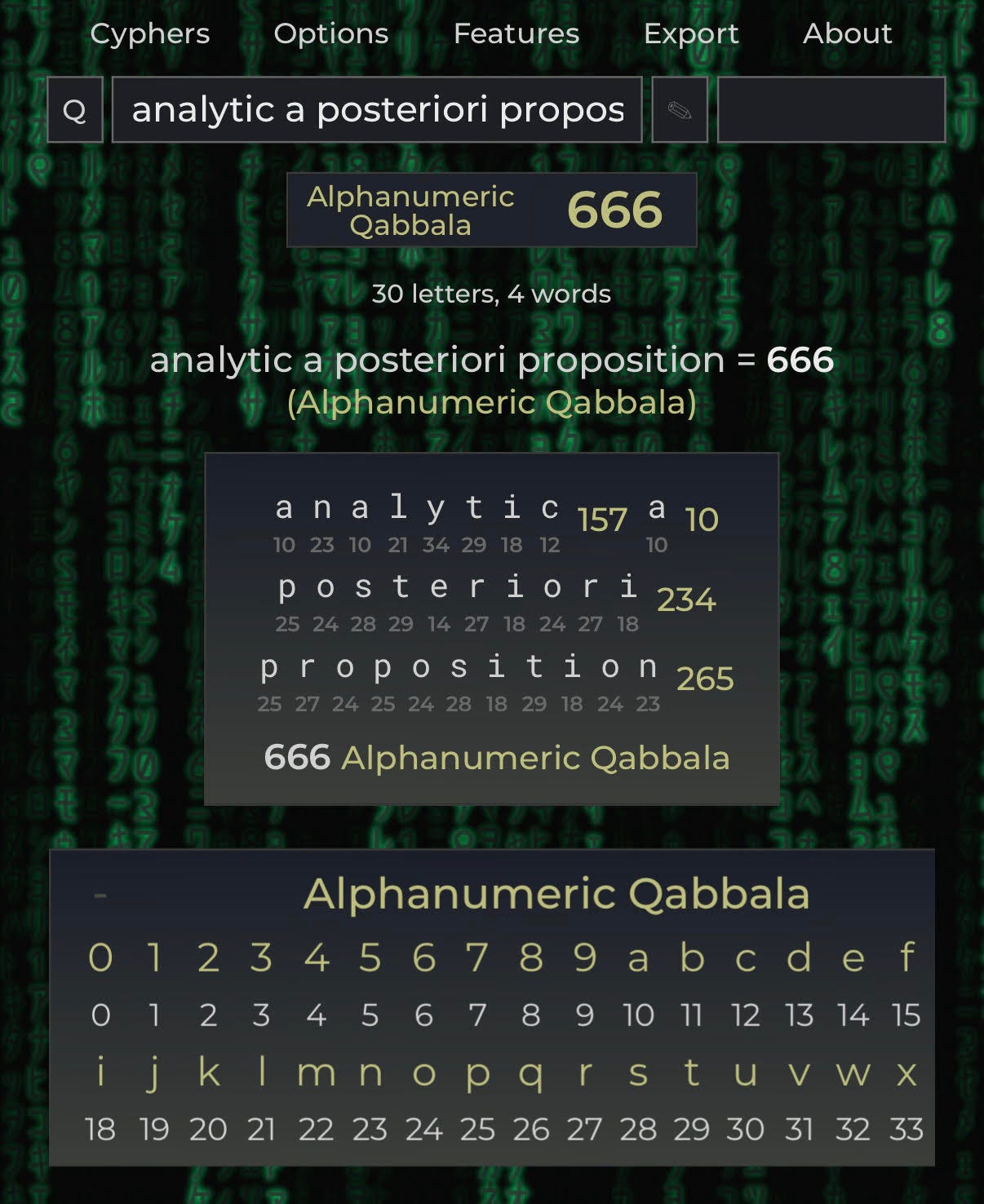
Oh, but wait . . . it gets even better. I just gematrically consulted the Lofty Powers and they have validated my analysis. Here, Dear Reader, is the occult cherry on top. In Alphanumeric Qabbala, “analytic a posteriori proposition” totals to 666. I shit you not. The Great Lemur Djynxx has confirmed that the analytic a posteriori is far more outlandish than we could have ever imagined.
Hi interesting article. Look forward to reading the full chapter. I always think for this discussion of convergent waves and retrochronic validation it helps to go back to where Nick Land misappropriated the idea from - namely, Gilles Deleuze and Félix Guattari.
In their plateau in A Thousand Plateaus called Apparatus of Capture, they discuss how the state has in some sense always coexisted with non-state social organisation. Instead of a zig zag development, evolutionist development, or even a ‘break’ as suggested by Pierre Clastres, they develop the model of reversed causality.
They give a few models to think about this, one of the is divergent and convergent waves. The state, as it actually emerges, is the divergent wave which reacts back on the surrounding non-state (e.g. hunter gatherer organisations) around it. But the state, in the capacity of a virtual thing that is warded off but also anticipated by those non-state communities, is also a convergent wave. When that wave actually converges it collapses along with the non state society, which ceases to be.
So when we are talking about the convergent wave of capitalism (in the capacity of artificial intelligence) it is non-identical with the divergent wave of capitalism-as-AI which will actually emerge. The ontological status of the former already has quite a nice conceptualisation by Deleuze and Guattari:
Firstly we can speak of it as virtual (real but not actual). But it might be more meaningful to use Deleuze’s notion of coexistence, or a molecular, perpetual field of interaction. I.e. forces within capitalism tend towards the destruction or development of capitalism (and capitalism-as-AI) as its own limit, likewise forces outside capitalism tend towards either the warding off or establishment of capitalism. All these forces coexistence and can draw one another into their power.
This is the sense in which Nick Land is or should be speaking: a molecular field of interaction.
The convergent wave is real but not identical to what it becomes. It’s a field of tendencies, not some hidden identity waiting to show itself.
So when this gets turned into ‘capitalism is artificial intelligence’, the more faithful reading is that there are tendencies within and around capitalism pushing toward something like AI, these form a kind of attractor, but whatever actually emerges won’t simply confirm what was already there, it will reshape the whole field, including what ‘capitalism’ even is.
This is why things can get weird by saying ‘analytic a posteriori’ - because it suggests AI was always already contained within capitalism, just waiting to be revealed by future experience. But on a Deleuzian (purist Landian) account there is no such containment, the virtual is not a hidden essence, actualisation is not revelation, and nothing gets retroactively proven to have always been true.
So that’s my little challenge to you here. But again, great work and love when people push Kant to breaking point. Can’t wait to see how you bring Žižek in!
I’m going to put out an article on exactly this topic (Deleuze on the emergence of the state, state-as-convergent-wave and so on) in a few days so check it out if interested.
Great piece